Interview by: Lieneke Hulshof for Miter Motley (feb/maa 2019)
Original in Dutch: Mister Motley (interview Lieneke Hulshof)
Download original pdf performance here
“The Quality Argument: the false opposition between ethnicity and/or gender and the quality of the work”
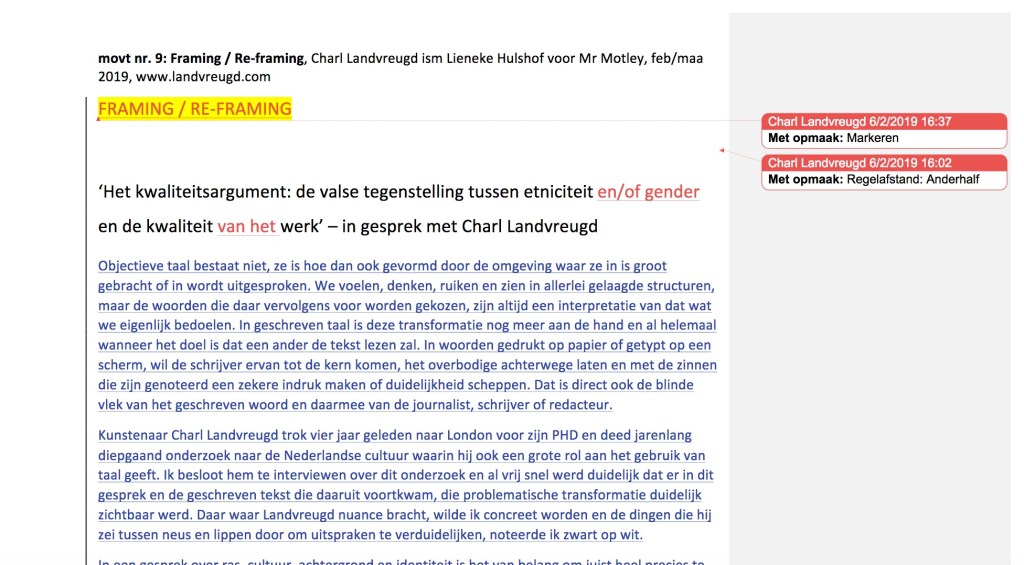
Objective language does not exist; it is always shaped by the environment in which it was raised or in which it is spoken. We feel, think, smell and see in layered structures, but the words we choose for these experiences are always an interpretation of what we actually mean. In written language this transformation is even more present—especially when the intention is for someone else to read the text. In words printed on paper or typed on a screen, the writer aims to get to the core, omit the unnecessary, and create a certain impression or clarity with the sentences that remain. This is also precisely the blind spot of the written word, and thus of the journalist, writer or editor.
Four years ago, artist Charl Landvreugd went to London for his PhD and conducted years of in-depth research into Dutch culture, in which he assigns an important role to the use of language. I decided to interview him about this research, and it quickly became clear that in both the conversation and the written text that followed, this problematic transformation became highly visible. Where Landvreugd offered nuance, I tried to be concrete, and I wrote down things he said casually—in passing—to clarify his points, in stark black and white.
In a conversation about race, culture, background and identity, it is crucial to be extremely precise about what is and is not written down. When I sent the interview to Landvreugd for review, he made corrections in Word, and I went over them again. The artist then wondered whether he even wanted the text published at all; I had written it in a very straightforward manner, and my interpretation of his words was coloured by my Western-formed, white perspective that longed for a degree of clarity. What he had been researching was happening here quite literally; not publishing the text would therefore also be a missed opportunity.
Charl Landvreugd suggested publishing the text—but including our corrections. Some sentences are crossed out, some words are unreadable, and certain answers have been expanded. Precisely to demonstrate how the transformation between thought, conversation and the written word works, and to show readers how strong the impulse is within Western journalism to turn layered, multivocal perspectives into a chronological narrative with a beginning and an end.

Key arguments from this interview turned performance translated to English:
1. Language shapes perception; objectivity does not exist
Language is never neutral. It is formed by the environment in which it develops and by the cultural conditions that shape its use. Human experience unfolds in layered modes of sensing, thinking and knowing, yet the words chosen to articulate these experiences are always partial interpretations.
Writing intensifies this process. The movement from thought to spoken word to written text reduces complexity in the pursuit of clarity, coherence or emphasis. This reduction produces blind spots: not everything can be expressed, and what remains carries the imprint of the writer’s positionality. In the cultural field, this limitation affects how narratives are constructed, how artworks are described and how meaning circulates.
2. The false opposition between quality and ethnicity/gender
A persistent misconception in the cultural sector is that the quality of an artwork can be evaluated independently of the artist’s ethnicity, gender or cultural background. This creates a false opposition, implying that identity contaminates objectivity. In practice, judgments of quality are always shaped by cultural, racial and gendered frameworks—especially when whiteness is treated as a neutral baseline.
This blind spot obscures the interpretive structures that govern evaluation. Recognising that quality is culturally mediated enables a more accurate and equitable understanding of artistic production.
3. The need for new vocabularies to describe non-white Dutchness
Contemporary Dutch society lacks a sufficiently nuanced vocabulary to describe forms of Dutchness that fall outside dominant white frameworks. As a result, cultural practices and identities emerging from Afro-Dutch, Indo-Dutch, and other diasporic communities are often misread, flattened or forced into outdated categories.
Developing new vocabularies is essential. These vocabularies must emerge from local continental European contexts and carry the capacity to articulate hybrid forms of belonging as legitimate modes of Dutch and European identity.
4. A “people-yet-to-come” who already exist
Theoretical language often treats culturally hybrid or diasporic communities as “people-yet-to-come”—identities that are emerging but not yet recognised. In the Dutch context, this is inaccurate. These communities are already present, shaping culture and society in real time.
Their presence complicates traditional frameworks of origin, authenticity and national belonging. Recognising this presence is key to understanding contemporary European culture as already hybrid rather than waiting to become so.
5. The transformation between thought, conversation and written word
Between thought, spoken exchange and written text, subtle but significant shifts occur. Spoken nuance—intonation, hesitation, emphasis, gesture—cannot be fully captured in transcription. In discussions about race, culture and identity, even small shifts can lead to misinterpretation or unintended fixity.
This is not merely a technical issue; it is a methodological one. Precision in representation requires acknowledging that writing always transforms meaning. Recognising this transformation is central to ethical artistic and curatorial practice.
6. The Western urge to flatten layered perspectives
Western journalism and cultural criticism often reduce multivocal, layered perspectives into linear narratives with a clear beginning and end. This prioritises clarity and closure over complexity and multiplicity, and it risks erasing tensions, contradictions and overlapping influences—precisely the elements that define hybrid cultural experience.
Rejecting this flattening is essential. Contemporary cultural analysis must be capable of holding several truths simultaneously and resisting the urge to simplify.
7. Hybridity as a baseline condition of the 21st century
Hybridity is not an exception; it is the structural condition of the 21st century. Migration, movement and cultural interconnection have reshaped identities across Europe and beyond. Artistic practices reflect this multiplicity through layered forms, shifting aesthetics and complex genealogies.
Understanding hybridity as a fundamental condition shifts how culture is evaluated. It reframes belonging as a process, identity as relational, and the visual arts as spaces where new European vocabularies are continually formed.
 CHARL LANDVREUGD
Leave a comment